Showing posts with label biology. Show all posts

Wednesday, November 28, 2012

Winter Break Bordem - Science Videos

This summer I had the wonderful joy of watching many talented YouTube artists make videos on our favorite topic: SCIENCE! Sure, we're a little late for the beginning of the year but just in time for Winter Break!

Here are a few of my favorite videos from this summer. If you find yourself wanting to learn some science this Winter Break but don't want to read those dusty textbooks check out some of these Youtuber's other videos.

1.) Paul G. Hewitt teaches the "Conservation of Momentum"
This video isn't new (2008) but it does show an entertaining way to teach a physics concept that can be difficult for students to grasp. Hewitt is a physics teacher, among other things, who is well known in the  science education world for writing a physics textbook that helped teach through analogies. His analogies and demonstrations not only make science more interesting and easy to understand but they are fun too!

2.) NPR (National Public Radio) is absolutely wonderful. They have a website and YouTube channel and their content ranges from politics to music and even science! This video here from NPR answers the question "How heavy is a hurricane?" Can you guess the weight of a hurricane in whales? The answer may surprise you.

3.)Vsauce- Michael Stevens is a science writer and the host of Vsauce. This channel has many interesting videos; some on video games, science news, fun things to-do online and nifty things people have created. Vsauce has a few side channels as well, including vsauce2, (new) vsauce3, and vsaucegaming. This video explains why people are ticklish and why some people think it is actually painful.


4.)Veritasium- America is definitely not the only country with scientists. This vlogger is from Australia and did his Ph.d on teaching science through videos. This video explains common misconceptions about temperature by interviewing people on the streets in Australia. Go ahead, watch this video and learn why some materials feel colder than others.

5.) Crashcourse is a new Youtube channel created by two brothers. Each brother tackles an AP subject. The first two subjects were World History and Biology. This is the first video in the Biology segment. (Just now starting is a segment on Ecology.) If biology is your thing you should watch these videos that are done by Hank Green, who got his Ph.D in environmental biology.

6.)ASAPscience - I recently came upon this science channel. Their tagline is "Got a burning question?" They have about 50 videos on many different topics in science. Ever wonder why people get hangovers? Want to know know about the age of earth? Or maybe you just wondered how Spiderman's powers work, this is the channel to keep an eye on.

7.) Is astronomy more your thing? SpaceLab is a youtube channel that has playlists of astronomy related things. They also have connections with the International Space Station. Neil DeGrasse Tyson has been interviewed a few times on their channel and their normal host is... Bill Nye the Science guy!

8.)SciShow is the place to go for science news. This channel is written and hosted by Hank Green (of CrashCourse) and mainly focuses on science news. There are some videos of explanation and even a few on labs you can do at home.

9.) MelodySheep - Lastly, this channel takes clips from movies, documentaries and speeches about different topics and turns them into a catchy auto-tune song of science! 

Sunday, March 25, 2012

Dynamic DNA Explained

Deoxyribonucleic Acid
What is it? 
We're sure you've heard of this term; Deoxyribonucleic Acid. No? How about DNA? Well good news, they are the same! DNA is the shortened way of saying the long molecule's name. DNA is known for its double helix shape.
DNA is made up of chemical bases, four to be precise, A, T, C, and G.
A: Adenine
T: Thymine
G: Guanine
C: Cytosine
These chemical compounds match up to one another; A to T and C to G.  This connection is called a base pair. There is another compound, Uracil, that can attach to Adenine, but this is a result of RNA, not DNA.
Double Helix / A-T and G-C pairing
So what is RNA?
We are glad you asked! RNA (Ribonucleic acid) is similar to DNA. They are both nucleic acids but they do different things. DNA is complex and holds secret messages in its makeup. (It's like a chemical spy holding all the secrets about you!) RNA is the only one who can understand these secrets. RNA, in a sense, translates these messages for proteins and other things; it transcribes the message DNA has.

DNA and RNA are also different in shape. Like we said, DNA has a double helix shape; this shape is like a spiral staircase. RNA however is single stranded. RNA has a a couple different shapes, depending on how its base pairs match up.
Shape of RNA/ C-G and A-U pairing
Where is DNA found?
DNA is found inside the nucleus of the cell. The nucleus is a great place for a nucleic acid! The nucleus is inside the cellular membrane of the cell though. How do we break open the microscopic cell membrane and the nucleus? Dish soap! The dish soap breaks apart the molecules of the cell. Both dish soap and the cell membrane have hydrophobic (scared of water) and hydrophilic (loves water) sides.

Why add contact solution, pineapple juice or meat tenderizer?
DNA is folded and cushioned by protein in the cell. The contact solution is acidic and separates the DNA from the protein.

How come the white stuff is DNA?
The DNA is the white, stringy stuff you see in the top layer of alcohol. Alcohol forms a layer on top of the water because it is less dense. Adding salt to the mixture (at the beginning) helps DNA stick together.  But when in water DNA is dissolved. Adding the alcohol brings the DNA 'out of solution', making it undissolved. This is called precipitation.


Further Information:
http://ghr.nlm.nih.gov/handbook/basics/dna
http://www.usask.ca/education/coursework/mcvittiej/bio30unit1/overheads/1.23.htm

Tuesday, March 20, 2012

Dynamic DNA

This week we're doing an experiment with DNA! Now doesn't that sound exciting? In this lab you will be able to see the very small DNA from a cheek cell or from inside a pea. The procedures for cheek cells and peas are a little different, so make sure you read the instructions.

Pre-Lab:
If you have access to a microscope we suggest you take a look at the cells in your mouth.
1.) Place a drop of iodine on a microscope slide.
2.) Take a toothpick and gently scrape the inside of your cheek.
3.) Place the toothpick in the iodine and swirl.
4.) Start with low power (4x) and look at your cheek cells!
Now that you have a general idea of what your cheek cells look like try this experiment.

Materials
- Spilt Peas, Strawberries or any other DNA source (if not using cheek cells)
- Blender
- Salt
- Water
- Measuring cups
- Test tubes
- Dish soap
- Contact Solution (meat tenderizer or pineapple juice)
- Rubbing alcohol (isopropyl or ethanol)
- Glass stirring rod (wood skewer or Q-tip)

Procedure:
Cheek Cells
1.) Swish salt water in your mouth for 30 seconds. (This is a long time, but you can do it!)
2.) Spit the water into a cup, then pour it into a large test tube.
3.) Add 1 teaspoon of dish soap to the large test tube.
4.) Gently shake the test tube. (If you do this in a beaker or cup, gently stir the cup)
5.) Pour about 1 teaspoon of alcohol into the tube.
The best way to do this is by tilting the test tube and slowing pouring the alcohol.
Ideally there will be a small layer of alcohol above the soapy mixture.
6.) Using the glass stirring rod - twirl in one direction to collect the DNA

Split Peas & Other Foods:
1.) In a blender add and blend on high for 15 seconds:
- 1/2 cup split peas
- 1/8 teaspoon table salt
- 1 cup water
2.) Pour the pea mixture through a strainer (you want the liquid) and let sit for 5-10 minutes
3.) Pour some of the liquid into a test tube
4.) Add 1 teaspoon dish soap to the large test tube
5.) Add some contact solution to the test tube 
(you don't need a lot, a small squirt or a pinch for tenderizer)
6.) Add about 1 teaspoon of alcohol to the test tube
Just like the cheek cells you want a layer of alcohol above the soapy pea mixture
7.) Using the glass stirring rod - twirl in one direction to collect the DNA

You can save this DNA or look at it on a wet slide under a microscope.
To save: Put the DNA in a small test tube or container with some alcohol.

(Pictures for the steps to come)

Further information:
http://www.middleschoolscience.com/microscope.pdf
http://www.pbs.org/wgbh/nova/teachers/activities/pdf/2809_genome_01.pdf
http://www.pbs.org/wgbh/nova/teachers/activities/2809_genome.html
http://learn.genetics.utah.edu/content/labs/extraction/howto/

Monday, January 30, 2012

Pop-able Pollutants Explained

It is best to say that people around the world are finding ways to go green.  We are noticing that most products we consume affects our Earth.  Through observations and experiences we've seen how our future generations are also affected.  One of the common environmental problems is water pollution.  Many water sources are being filled with toxins.  Our lakes, oceans, rivers, streams, and ground water are being contaminated with a toxin known as phosphate (pronounced fos-fate).  This white powdery (in)organic nutrient can be dissolved in water.  Similar to nitrogen, it is commonly found in fertilizers and detergents.  When too much phosphate is being drained into the water, it becomes hazardous.


Courtesy of http://fairforall.org.
When phosphate finds its way into water sources, it begins to feed many organisms.  It fertilizes many of the plants causing an exponential growth of algae, known as algal bloom.


China algae out break.  Courtesy of http://www.ctv.ca
 Algae's function in the water system is to collect and provide oxygen in the water. When there is too much algae, two things can happen. 
One:  An excessive amount of oxygen is produced and suffocates aquatic creatures.  
Two:  Sunlight will not reach certain algae to produce energy or nutrients which causes them to die.  As the algae decompose (or die) at the bottom of the water bed, it releases toxins which eliminates the oxygen in the water.  No oxygen means no life for any of the water plants or creatures. 


Can you imagine all the areas affected by algal blooms?

Resources:
Photo of phosphate.  Retrieved from http://fairforall.org/2011/01/28/the-western-sahara-conflict-is-closer-than-you-think/

Algae Alternative Inc.  (2005).  Laundry detergent ingredients. Retrieved from http://www.laundry-alternative.com/detergentsinfo.htm

City of London. (2012).  Understanding phosphorus, the need for reduction and the effect of too much phosphorus on the environment. [24 January 2012]  Retrieved from  http://www.london.ca/d.aspx?s=/Sewer_and_Wastewater/Phosphorus.htm

The Associated Press.  (2010).  Big algae bloom expanding off China's east coast.  Retrieved from http://www.ctv.ca/CTVNews/SciTech/20100625/algae-bloom-china-100625#ixzz1kM3uiZj5


Additional Websites:
National Geographic (2010).  World's largest dead zonehttp://news.nationalgeographic.com/news/2010/02/100305-baltic-sea-algae-dead-zones-water/

Making an algal bloom.  http://serc.carleton.edu/eslabs/fisheries/7_a.html

Sunday, January 29, 2012

Pop-able Pollutants

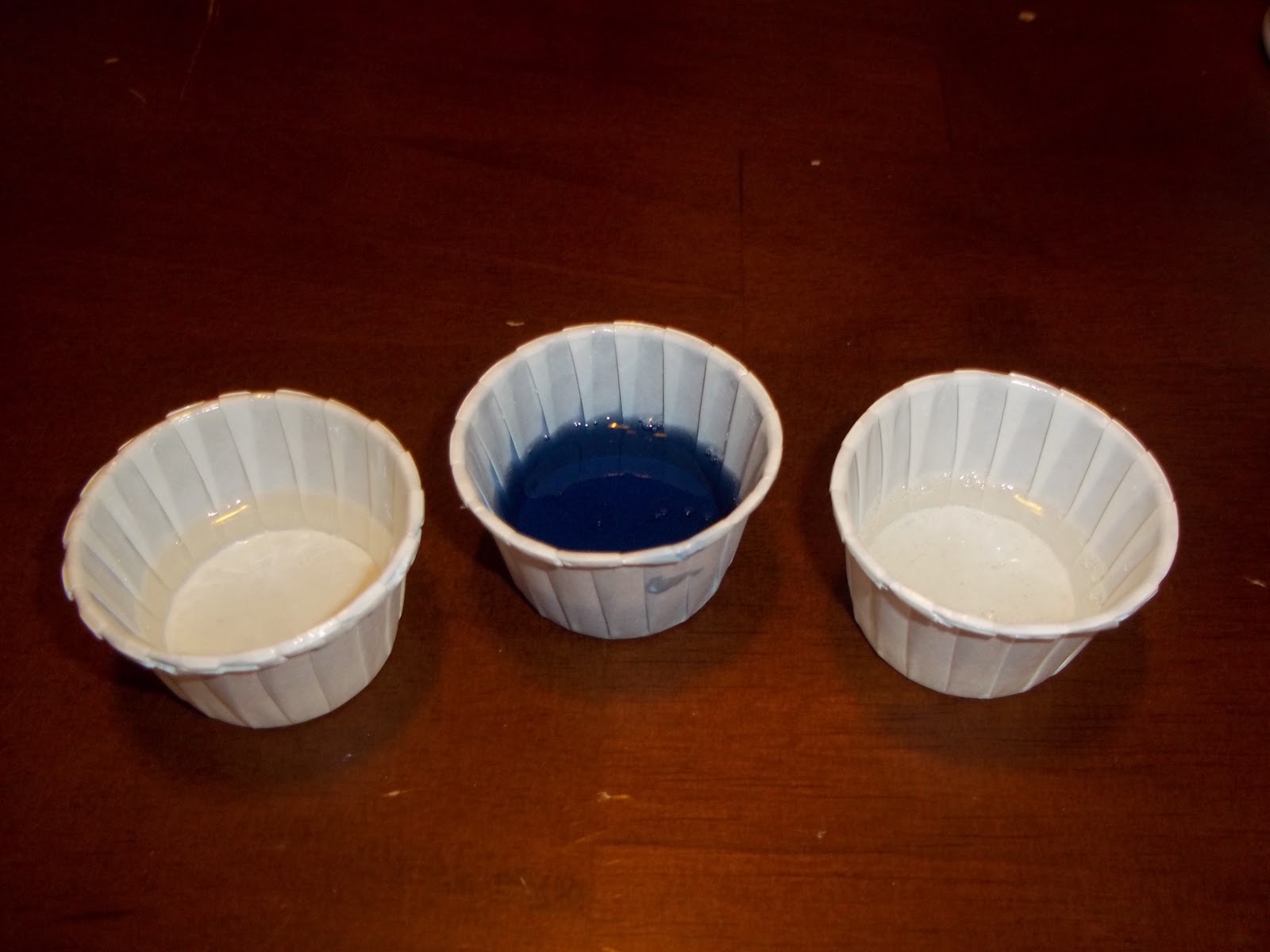
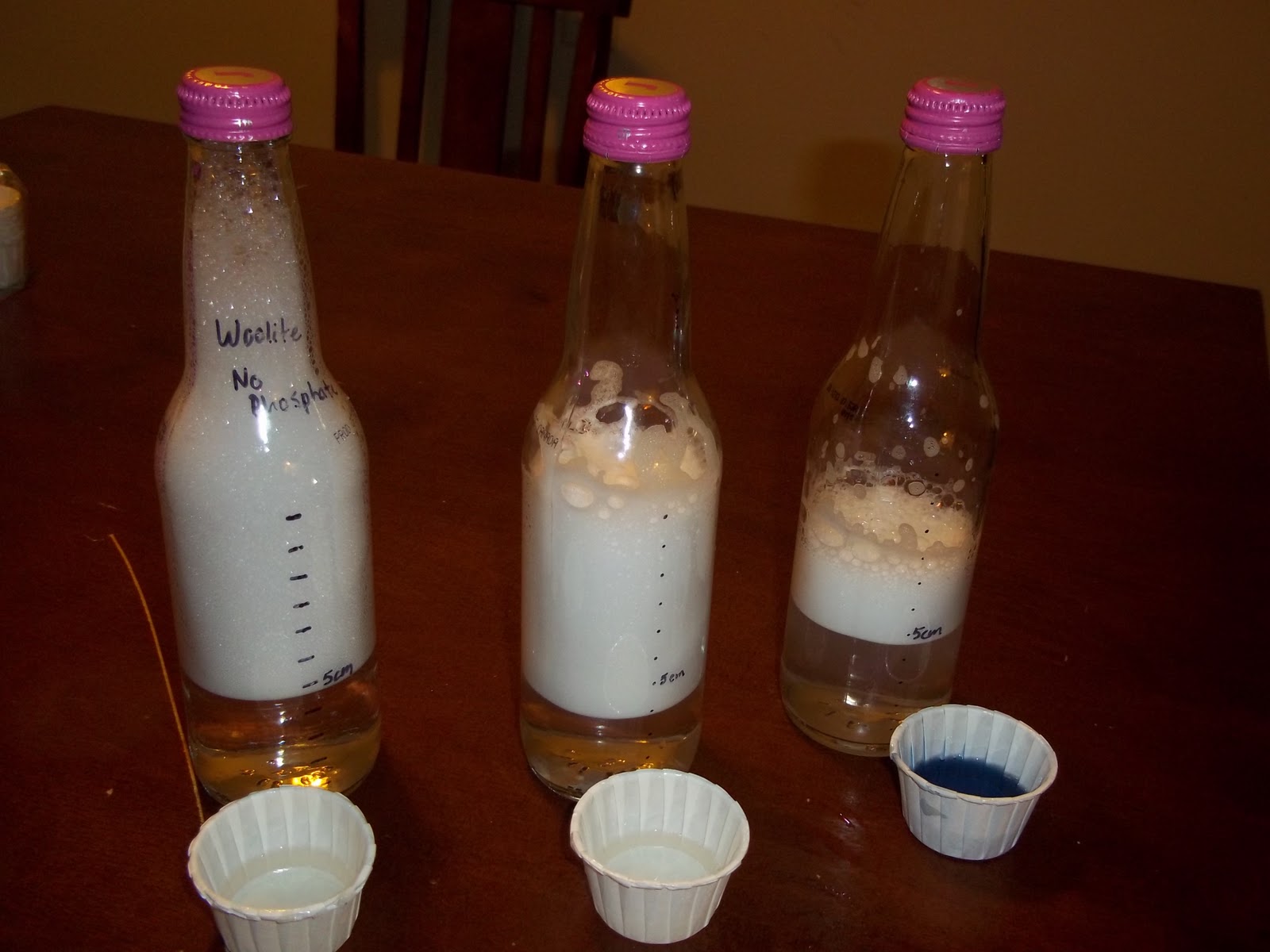
Before consumers knew that their products affected the environment, many laundry detergents contained an ingredient called phosphate. Phosphate minerals remove hard water minerals, prevent dirt from clinging back to clothes, and create suds; but phosphate is bad for the environment. This experiment helps us observe the amount of phosphate that could be in the detergent by the suds buildup in the container.

*Phosphates is no longer found in laundry detergent, but there are other detergents that might still contain phosphate in their ingredients.*
Materials:

(1) Three clear containers of the same size with a lid 
(jars or water bottle)
(2) Three detergents (with various percentage of phosphate)  
(3) Water
(4) Scissors, ruler, permanent marker, teaspoon, and paper
Procedure:
[Step 1] 
Take a blank piece of paper and a ruler.  Draw points in 1 centimeter increments. 


[Step 2]
Cut out a strip to use as a bendable ruler.

[Step 3]
Place the marked paper against the bottle.  Make sure  0 centimeters is aligned with the bottom of the bottle or jar.

[Step 4]
Mark the centimeter increments on the the bottle or jar using the permanent marker.

[Step 5]
Fill the bottles with water to the halfway mark. 

[Step 6]
Fill each bottle with a teaspoon or proportionate amount of  specific detergent.
For these 14 oz. bottles we added half a teaspoon or less of detergent. For 16 oz. bottles it is suggested to use a teaspoon of detergent.


[Step 7]
Seal the bottle and shake the solution. 
For the experiment there should be 3 trials.
Trial 1:  Shake for 1 minute.
Trial 2:  Shake for 5 minutes.
Trial 3:  Shake for 10 minutes.

[Step 8]
After mixing the solutions, observe the amount of bubbles that have been created.